
Renting an Apartment in Prague as a Foreigner: The Documents You Need
Renting in Prague as a foreigner is completely normal; what trips people up is the paperwork. Here are the documents you need to be the landlord's easy yes.
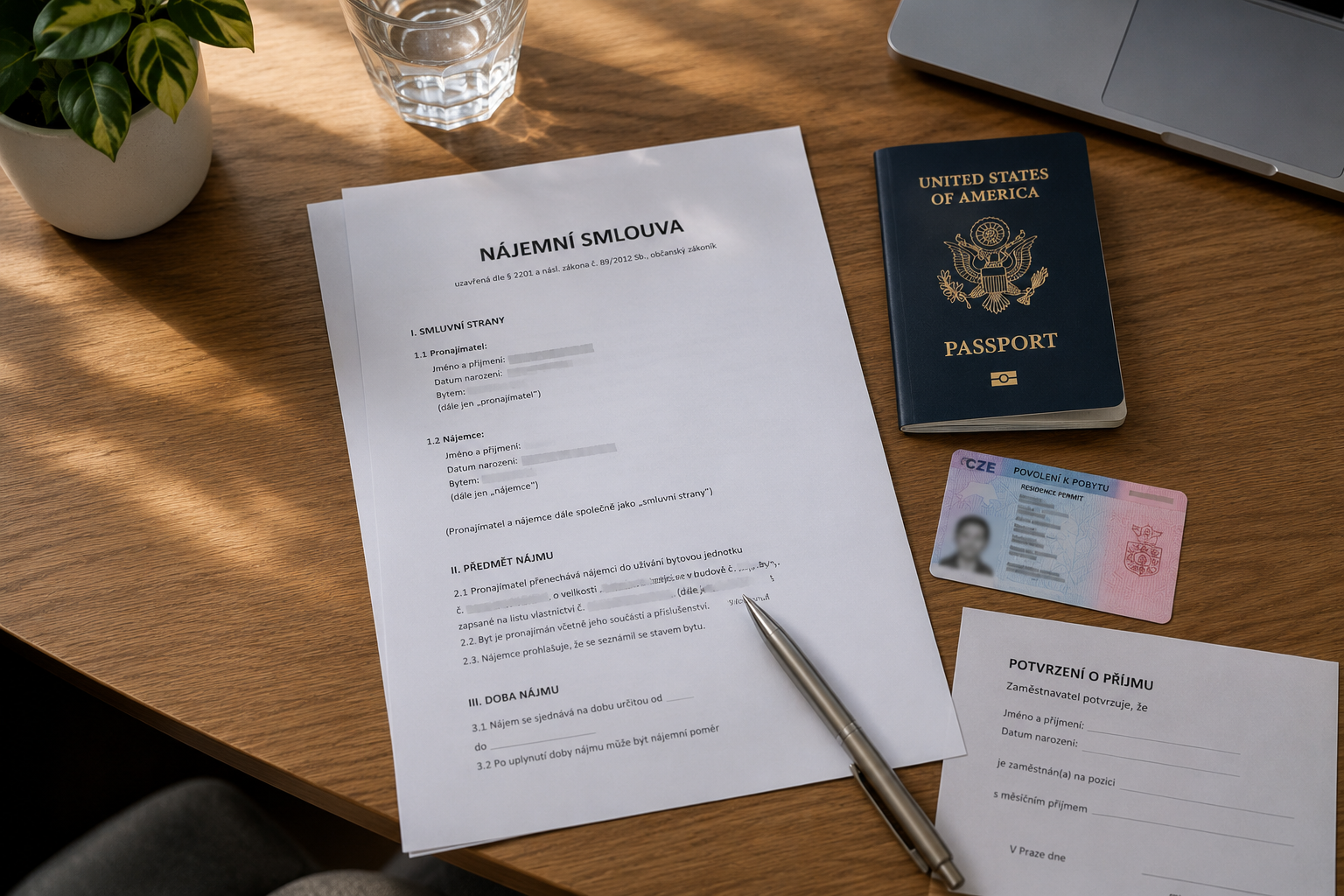
Prague's rental market moves fast, and as a foreigner you're often up against locals who already have all their paperwork ready. The good news: renting here as a non-Czech is completely normal, and landlords do it all the time. What actually slows people down is showing up without the right documents. Here's what you need, and how to make your application the easy yes.
Can a foreigner rent in the Czech Republic?
Short answer: yes, without restriction. No law stops non-citizens, EU or non-EU, from renting a flat here. You don't need permanent residency or Czech citizenship. What a landlord cares about is simpler and more human: can you pay the rent, and will you be a reliable tenant? Your job is to make both easy to believe.
The core documents
Have these ready before you start viewing, ideally as clean photos or PDFs on your phone:
- Photo ID: a passport (non-EU) or national ID card (EU)
- Proof of legal stay: your visa or residence permit if you're non-EU (EU citizens don't need this)
- Proof of income: a work contract, recent payslips, or for freelancers a few months of bank statements plus your zivnostensky list (trade licence)
- Czech bank account details: not always required, but it makes paying rent smoother and reassures landlords
If you're a student, a confirmation of study (potvrzeni o studiu) plus a guarantor, often a parent, can stand in for an income history.
The lease itself
Czech law requires a residential lease to be in writing, no matter how long it runs (Section 2237 of the Civil Code). Never rely on a verbal agreement. Before signing, check that the contract names all tenants, states the rent and what's included, lists the deposit amount (capped at three months), and sets the notice period. If it's only in Czech and you're not confident, get it translated or run it past someone who reads legal Czech. Don't sign what you can't read.
What an agency (realitka) will ask for
Going through an agency means a bit more formality. They'll usually ask for ID, proof of income, and sometimes a reference from a previous landlord. Many also charge a commission, typically one month's rent plus 21% VAT, so confirm who pays it before you commit. A real agency has a registered company, a written mandate to rent the property, and no problem answering questions. Pressure to pay anything before a viewing or signing is a red flag.
How to win a flat in a tight market
In Prague's busier seasons (late summer especially), good flats go in days. You stand out by removing the landlord's risk:
- Reply fast and be specific about your situation and move-in date
- Bring your full document set to the first viewing; being ready to sign on the spot is a real advantage
- Offer to pay the deposit and first month promptly by bank transfer
- Be honest about your job and length of stay; landlords value predictability over a perfect CV
What it will cost upfront
Budget for more than the first month's rent. A typical move-in means first month's rent, a deposit of one to three months, and (if you used one) the agency commission. On a 20,000 CZK flat with a two-month deposit and a one-month agency fee, that's potentially 80,000 CZK or more before you've unpacked a single box. Knowing this in advance is half the battle.
Renting in Prague as a foreigner isn't hard; it just rewards being prepared. Have your documents ready, insist on a written lease, and treat the first viewing like the interview it is. And when you're deciding where to look, or whether to share a place to split those upfront costs, that's where DomuHQ comes in.
Source: lease requirements above reflect the Czech Civil Code (Act No. 89/2012 Coll.). General information, not legal advice.